

photo: Michael Potts
p 2/3
Human Body
the art of seeing ourselves

Christopher Robledo
Boston, MA
Adorned
The artist is a photographer drawn to honest moments and emotional nuance. His work focuses on connection between people, light, and the quiet details often overlooked. Blending mundane with a cinematic eye, using expressive framing and light to elevate everyday moments into something emotionally resonant.
Rather than staging perfection, the artist looks for authenticity, allowing each photograph to tell a story that feels lived-in, human, and real.

Elena Paraskeva
Ayia Napa, Cyprus
Beauty Unseen
Curator Note: These two photographs engage adornment as intervention—what happens when the body is dressed, marked, or arranged against expectation. In the first image, a muscular male torso is framed frontally, the head partially visible, the gaze neutral. The corset—delicately embroidered, traditionally coded as feminine—cuts across the chest and abdomen. It constrains and decorates simultaneously. The tension is not theatrical; it is controlled. Strength remains visible in the shoulders and arms, yet the garment reframes that strength. The body is neither disguised nor caricatured. Instead, it becomes a site of negotiation between gendered symbols. The corset does not weaken the figure; it complicates it. The second image turns the body away from us. A nude figure sits folded forward on a pedestal, back exposed, spine aligned vertically with a precise line of green grapes descending from neck to lower back. More grapes crown the head. The background curtain, equally green, creates a near-monochrome field that intensifies the sculptural quality. The fruit introduces artifice and abundance—echoes of classical still life—while the pose remains protective and inward. Beauty here is curated, almost staged, yet the body beneath it is quiet and vulnerable. Together, the pair addresses decoration not as embellishment but as statement. In one, clothing challenges inherited binaries; in the other, organic ornament transforms the body into tableau. Both works suggest that what we place upon the body—fabric, fruit, symbol—reveals as much about cultural expectation as about the flesh itself.

Hossein Fardinfard
Esfahan, Iran
So far, So close
Taken during Independence Day in Tbilisi, Georgia, a day filled with street celebrations and public events.
While I was photographing a boy jumping on a trampoline, his trainer accidentally stepped into the frame to call the other students to prepare for the next round. That unplanned moment is what ultimately shaped this image.

Ivan Wentland
Kailua, HA
Mirror Me
A self portrait using my iPhone on self timer with the help of a few mirrors.
Curator Note: Hossein Fardinfard’s Independence Day photograph is built from accident and timing: a public scene snaps into a clean graphic—trainer’s arm extending like an arrow, the boy suspended upside down, body reduced to silhouette and trajectory. It reads as instruction, risk, and trust, with the human body briefly becoming pure motion and direction. Ivan Wentland’s iPhone self-portrait turns the body into a constructed space. Mirrors fracture scale and orientation—hand, torso, and reflection contradict each other—so the subject becomes both maker and material. Together, these two photographs hold opposite ends of the same question: how a body is shaped by forces outside it (gravity, guidance, spectacle) and by the quieter force of self-regard (control, fragmentation, choice).

Andrew Wohl
Bethesda, MD
Alex's Tattooed Hand
Though the artist specializes in Street Portraiture (as distinct from Street Photography), focusing on the captivating faces of his subjects, he discovered that the human hand can, at times, be just as expressive. Whether tattooed, holding a cigarette, resting on a ladder, raised in ecstasy while celebrating Holi, the Hindu recognition of spring or even multi-colored, the hand can say as much about a person as their face.

Hossein Fardinfard
Esfahan, Iran
Untitled
This image reflects the physical strain the artist experienced in his hands from prolonged computer work hours spent using a mouse, day after day. The pain became persistent, settling into the wrist and palm, turning an invisible discomfort into something deeply felt.
By isolating the hand and marking points of tension, the photograph speaks not only about the artist's own experience, but about a wider condition of contemporary life, where repetitive digital labor quietly reshapes the body, often noticed only when pain appears.
Curator Note: Both photographs isolate the hand as a primary vehicle of meaning, yet they approach it from opposite temporal directions. In Wohl’s street portrait, the hand is weathered, marked, layered with texture. Tattoos blur into wrinkles, dirt settles into creases, fingernails carry traces of labor. The hand rests, clasped over fabric, heavy with use. It suggests biography—time accumulated in skin. The image does not dramatize; it observes. Expression emerges through density of detail. This is a hand that has acted in the world. In Fardinfard’s *Untitled*, the hand is stripped of external narrative. Suspended against darkness, it is rendered almost clinical. Two small red points puncture the monochrome field, mapping invisible strain. Rather than history, the image presents condition. Pain is localized, diagrammed. The hand becomes evidence of repetitive, contemporary labor—digital rather than manual. Placed together, the photographs articulate two forms of inscription. One shows the body marked by lived experience and physical work; the other reveals the quieter imprint of technological routine. Both rely on restraint and close framing. Both refuse spectacle. In each, the hand functions as testimony—either of a life visibly worn into the skin, or of a discomfort that remains largely unseen until it demands attention.

Giorgio Tagliacarne
Rome, Italy
Holding
The artist is drawn to the human body as a place where lived experience becomes visible. In this image, care is expressed through closeness and weight rather than gesture or emotion. The interested in moments where the body holds responsibility and tenderness at the same time, without performing for the camera.
The approach is observational and intuitive, working with natural light and real situations, allowing the image to emerge through attention rather than direction.
Przemysław Gawłowski
Wroclaw, Poland
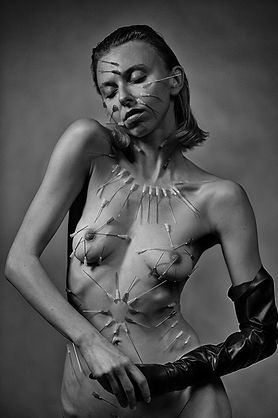
Phantom Pain
The artist is a photographer and designer whose work focuses on the human subject and the expression of the body. During photo sessions, he creates a space of freedom and trust, engaging in a creative dialogue with the photographed person. He specializes in portrait photography, creative photography, and staged projects including bodypainting and fine art nude.
Curator Note: These two photographs approach the body from radically different vantage points, yet both refuse spectacle in favor of physical truth. In the first image, the body is defined through function. A mother stands in open daylight, her torso exposed not as provocation but as necessity. The child’s weight, the grip of small fingers, the vessel of water in her hand—everything is anchored in lived reality. Care is not sentimentalized; it is structural. The body here is sustenance, labor, continuity. Responsibility is visible in muscle, posture, and balance. Nothing is theatrical. The image trusts proximity and natural light to carry meaning. The second photograph turns inward. The body becomes a site of controlled intervention—pierced, marked, stylized. It operates within a constructed space where vulnerability and artifice coexist. The needles radiate like constellations or wounds; the pose oscillates between surrender and composure. Unlike the first image, where the body holds another life, here the body holds tension—between pain and aesthetic control, between exposure and authorship. It is staged, deliberate, self-aware. Placed together, the photographs trace two conditions of embodiment: one shaped by obligation and environment, the other by intention and performance. One body sustains; the other interrogates. Both insist that the human body is not neutral. It carries weight—whether of a child or of concept—and in doing so, reveals the frameworks in which it exists.

Mari Saxon
Schrewsbury, MA
Self Love Club. Safe at Home
Kseniia Sanna
Tbilisi, Georgia
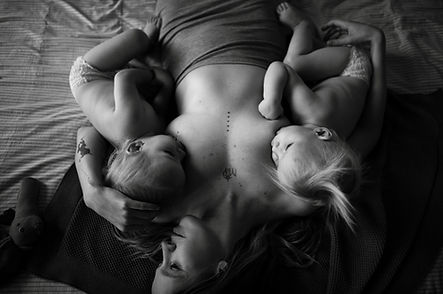
Three Hearts
At home comes a sense of safety — for a moment, Sophie can relax.
Curator Note: Both photographs center the body within the domestic sphere, yet they articulate care in distinctly different ways. In the first, the mother’s body becomes axis and shelter. Seen from above, her torso anchors the composition while two small children mirror one another on either side, nursing in quiet symmetry. The image is intimate but unsentimental. The line of dots down her spine reads almost like a seam—marking the body as both vulnerable and resilient. Here, nudity is functional, necessary, stripped of spectacle. The body exists as sustenance. The second photograph reclaims the bedroom as a site of self-regard rather than service. The figure lies alone, bathed in soft window light, surrounded by pillows, blankets, and childhood objects. The palette is warm, saturated, interior. Unlike the first image, no one else draws from her body. Her hands rest over her chest not defensively, but deliberately—an act of possession, of acknowledgment. The nudity here is not maternal; it is personal. Together, the pair stages two forms of intimacy within the same terrain. One body gives outward, sustaining others; the other turns inward, asserting presence without apology. In both, the domestic setting becomes a site of truth—where the body is neither performed nor hidden, but lived.

Lance Pressl
Deerfield, IL
Flesh
The artist explores the interplay of lines, shadows and form. Some have suggested he sees the material world differently than others, which gives him the special ability to capture unique and compelling images. Every image captured is done with the intent to tell a story or evoke an emotion. Among his many interests, he is fascinated by the human body and uses traditional and nontraditional representations to capture the curiosity of his audience. A common feature of his work is the juxtaposition of a human figure with a single object to reveal new and unexpected relationships.

Kseniia Sanna
Tbilisi, Georgia
Holding His World In Her Palm
I speak furtively about man in the language of God's love.
Be imbued with this love too.
Curator Note: Both photographs reduce the human body to touch — but they approach it from opposite directions. In the first image, flesh is abstracted. Hands press, pull, and stretch skin into ridges and shadows, transforming the body into terrain. The surface becomes sculptural, almost architectural. Light carves every fold and pore, emphasizing density and resistance. The gesture is deliberate, analytical. The body is material — something to examine, manipulate, and understand through tension. In the second image, the body is not stretched but supported. A small hand rises, tentative and open, while an adult palm cradles it from below. The light is softer, the contrast less confrontational. Here the body is fragile, emerging rather than resisting. The composition centers not on force, but on protection. The hand does not shape the flesh — it holds it. Together, the pair reveals two fundamental relationships to the human form. One investigates structure and surface, asking what the body is made of. The other considers devotion and care, asking what the body is for. Between pressure and protection, between sculpted abstraction and quiet guardianship, the exhibition’s theme expands: the human body is both substance and sanctuary.
Jamie Jackson
Tampa, FL
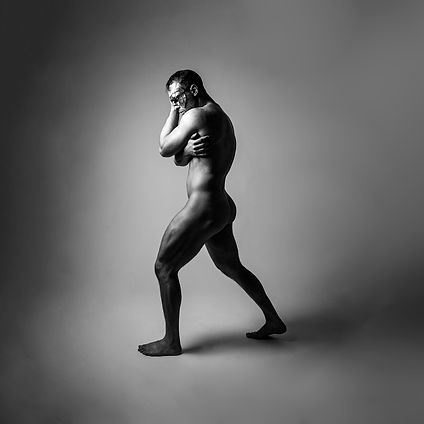
Male Nude Standing
The artist uses the medium of photography to capture an entire story within a single frame. It only
takes a second to capture an image—but the story that image tells can last for years.
.jpg)
Seth Cook
Atlanta, GA
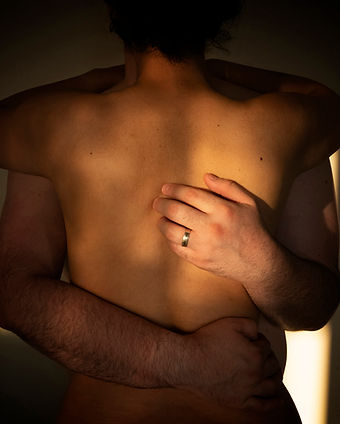
Mehr (Embrace)
The artist speaks to those who have navigated love across borders shaped by geography, language, or emotion. It is an invitation to see meaning in the spaces between words and to embrace the quiet beauty of culture and intimacy.
Curator Note: Both photographs engage the male body, but they dismantle very different versions of masculinity. In the first, the figure stands alone against a seamless backdrop, caught mid-step. The pose suggests forward motion, yet the arms cross inward—one hand shielding the face, the other gripping the torso. The musculature is defined, controlled, almost classical, but the gesture contradicts that strength. It is a body capable of assertion choosing instead to guard itself. The mask across the eyes complicates this further: visibility and concealment occupy the same space. The image feels restrained, self-conscious, suspended between exposure and defense. The second photograph abandons isolation. Here, the male arms encircle another body from behind, hands resting gently across the back and waist. The ring on the finger is small but declarative—a detail that grounds the intimacy in commitment rather than abstraction. Warm light replaces the clinical neutrality of the studio. The bodies are close, unmasked, integrated. Strength is no longer displayed; it is softened. Together, the pair moves from guarded autonomy to relational vulnerability. One man braces himself against the world; the other offers support within it. In both, the male body is fully visible, yet what defines it is not power but tenderness—either withheld or given.

Louis Bryant
Sacramento, CA
Compression
I see photography as both a record and a bridge: a way to preserve moments that might otherwise fade and to connect audiences across boundaries of culture, geography, and circumstance. My portraits and documentary work seek out gestures of resilience, grace, and vulnerability, while also confronting the silences created when lives are rendered invisible.

Pat Berrett
Albuquerque, NM
Nikki
This image is from a series titled "Torsos" that examines different bodytypes and stereotypes.
Curator Note: These two works approach the body from different emotional temperatures, yet they meet in a shared refusal to look away. In *Compression*, the figure folds inward, limbs wrapped tightly around the self. The body becomes both shelter and containment. Dirt, shadow, and tension compress the frame, narrowing our access. The gaze—partially concealed—remains alert. The image does not aestheticize suffering; it insists on presence. It positions photography as witness: a bridge between what is endured privately and what must be acknowledged publicly. By contrast, *Torsos* presents the body upright, exposed, and unembellished. There is no narrative gesture, no protective curl. Instead, light traces texture—skin, stretch, weight—without apology. This is not an abstracted ideal but a lived body, marked by time and biology. The series’ examination of stereotypes is not rhetorical; it is visual. The photograph asks what we think a “torso” should look like—and then quietly dismantles that expectation. Placed together, the works complicate visibility. One body contracts under pressure; the other stands in still confrontation. One reveals the psychic compression imposed by circumstance; the other challenges the aesthetic compression imposed by culture. Both resist erasure. Together, they assert that the body—however burdened, however judged—remains a site of resilience and truth.
copyright 2026 Decagon Gallery